
Teen Parties at Home: Independence, Boundaries, and the Power of the Crowd
In early November, police in McLean, Virginia, responded to a party that neighbors said drew as many as 300 teenagers. Officers reported fireworks and apparent underage drinking. The homeowners now face charges of contributing to the delinquency of a minor and maintaining a common nuisance, and they maintain their innocence. A few weeks earlier in Silver Spring Township, Pennsylvania, police called to a loud Halloween party charged a couple with furnishing alcohol to minors and corruption of minors. And in Warrington, Pennsylvania, police said they found about 150 teenagers at a Halloween party, and the parents were charged. A judge later dismissed every charge, and the parents’ attorneys said social media had hijacked their son’s party.
I’m not suggesting any of these parents are guilty of anything. Charges are not convictions, and in one case the charges are already gone. But every story follows a familiar arc: a gathering grows beyond what anyone planned, police arrive, and the parents end up taking the blame.
When your teenager asks to host a party, your brain probably flashes a rapid-fire slideshow of worst-case scenarios: ruined items, uninvited crowds, underage drinking, and neighbors calling the police. Your kid, however, hears something entirely different: a golden ticket to feeling included and tasting a tiny bit of sweet independence.
We all want to be the welcoming house where the kids want to hang out. But we also want to know how “a few friends” actually stays a few friends, and what on earth we’re supposed to do when uninvited guests start arriving, the crowd swells, and a harmless hang-out turns rowdy.
When a crowd of teenagers gets large enough, something shifts. Psychologists call it deindividuation: when kids feel anonymous in a crowd, their sense of personal accountability drops. Good kids who would never damage property or break rules on their own can get swept up in the energy of the group. They lose their individual filter, assuming someone else is in charge or that no one will single them out.
The real question isn’t, “Do I trust my kid?” It’s, “How big a crowd can I actually manage before the crowd starts making the rules?” We get into trouble when we treat those as the same question.
Start with Connection, Then Set Limits
Before you let out an instinctive “Absolutely not,” sit down and ask your teen what they actually want out of the night. Once you understand what they’re hoping for, you can talk about what’s possible, even if their first guest list is wildly, hilariously optimistic.
Try saying: “I want you to have a blast, but we need a plan I can actually manage without losing my mind. Let’s figure out what that looks like.”
Your teen can handle the playlist, the snacks, and the vibe. You keep absolute veto power over the guest list and the ground rules. If they throw out the classic “You just don’t trust me!”, don’t take the bait: “I do trust you. But managing a crowd of teenagers is an adult’s job, not yours.”
Talk About When the Plan Fails
It’s easy to agree to “no drinking, no drugs, and no extra guests” in preparation to the party. The harder, more important conversation is about what happens when things get out of control in real time.
Some parents believe that letting teens drink at home keeps them safe, however, the American Academy of Pediatrics (AAP) says that’s misguided. Alcohol and drugs impair judgment, and parents can’t keep impaired teens safe.
Before the party, ask your teen:
“What would you do if a friend brought alcohol or drugs?”
“What if someone showed up with three extra people?”
“What if someone felt sick from drinking but begged you not to tell me?”
Give them an easy out: “You can always come get me. If you need to blame me to save face, do it. ‘My parents are being psycho and ending this’ is a perfect excuse.”
Keep It Small Enough to Supervise
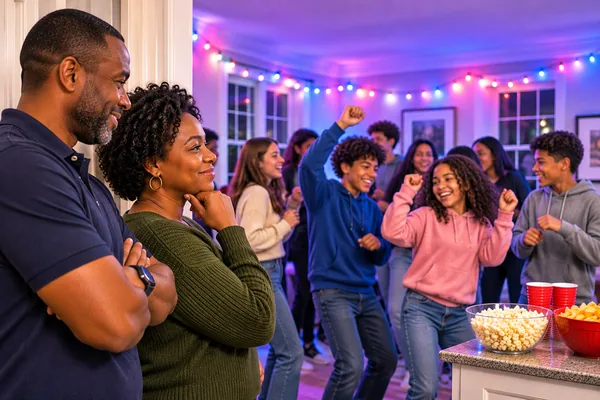
The AAP recommends keeping parties small, with roughly one adult for every 10 to 15 teenagers and at least one adult present the entire time . Don’t host alone. If you have to take a child to the hospital, you need a second adult to stay behind.
Before your teen sends a single invitation, work through these five essentials:
Control the door and the tech. Agree on a named guest list, a maximum headcount, and firm start and end times. If your child invites friends through social media, insist the event be strictly invite-only, never public. Set a firm “no crashers” rule and decide exactly what you’ll say to uninvited guests at the door.
Communicate directly. Talking with other parents is your best prevention tool. Text or call them to confirm start and end times and to remind them it’s a substance-free gathering. If your teen is going to a party elsewhere, call the hosts to make sure they’ll be home supervising. If you can’t confirm that, don’t let your teen go.
Stay involved (but not awkwardly). Plan to be home, sober, and available. Greet the kids, keep the lights on, and agree on which rooms are off-limits. Lock up your own alcohol and medications beforehand. Walk the yard and remove hazards, like building materials or sharp tools, that a teenager might trip over in the dark.
Provide carbohydrates. Feed them. Food in the stomach slows how quickly alcohol is absorbed, although it is not a safety net. Baking cheese and tomato pizzas and cutting them up quickly is your best tactical weapon, because it gives you a natural excuse to patrol the darker corners of the party. Skip messy condiments and anything with projectile potential (like tangerines).
Set stopping points and ride plans. Decide ahead of time what will make you shut the gathering down, such as large, uninvited crowds, substances, or property damage. Make it a rule that a guest who leaves can’t come back. Confirm safe rides home before the night starts. If a teen is impaired, call their parent for a safe handoff, and never let them drive.
The Safety Pact
Tell your teenager and mean it: “If someone is in trouble, come get me. Even if you broke a rule. We’ll deal with safety first and talk about the rules later.”
If a teen can’t be woken up, is breathing slowly, or shows signs of an overdose, call 911 immediately. Don’t waste time trying to figure out what they drank or took. Stay with them until help arrives.
You don’t have to host a party that makes you anxious to prove you’re a supportive parent. The goal is to give your teen room to laugh and connect without asking them to carry more weight than their shoulders can handle.
This article provides general parenting information, not individualized legal or medical advice. The cases mentioned above are based on news reports; charges are allegations, not findings of guilt. In an emergency, call 911.

Michael Oberschneider, Psy.D, NCCE, NCPC, is a Nationally Certified Custody Evaluator and Parenting Coordinator in private practice in Northern Virginia. Much of Dr. Oberschneider’s practice is dedicated to working with families who are going through high-conflict divorces. www.ashburnpsych.com